
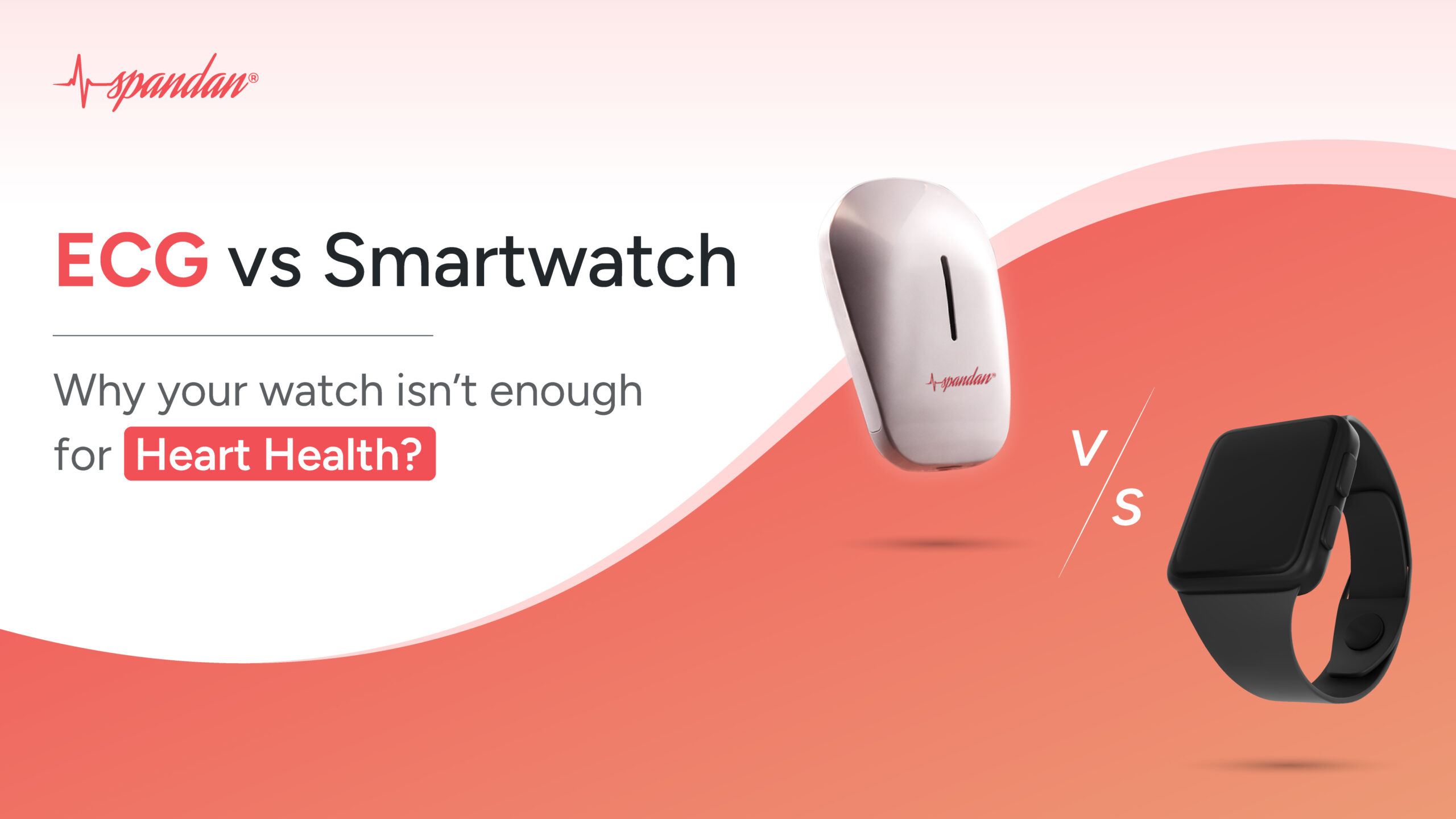

ECG vs. Smartwatch: Why Your Watch Isn’t Enough for Heart Health
Table of Contents
The ECG vs smartwatch debate is one of the most important conversations in modern heart health — and most people are on the wrong side of it. Silicon Valley has successfully put a heart monitor on the wrists of millions of people. From the latest Apple Watch to high-end Samsung and Fitbit devices, the “Wrist-ECG” is now marketed as a revolutionary life-saving feature. On the surface, this seems like a dream come true for preventive healthcare. We are told that our watches can detect irregular rhythms, monitor our sleep, and “keep an eye” on our hearts 24/7.
However, as cardiologists and emergency room doctors are increasingly finding, there is a dangerous side to this convenience. The ECG vs smartwatch gap is not just about features — it is about a massive, life-threatening difference between lifestyle tracking and clinical diagnostics. While your smartwatch is great for counting steps or calories burned, it is often completely silent when a real cardiac emergency — like a heart attack — strikes.
In this guide, we will dive deep into the science of electrocardiography, the physical limitations of wearables, and why a medical-grade device like Spandan is the only way to truly monitor your heart with confidence.
The Illusion of the "Wrist-ECG"
To understand the ECG vs smartwatch difference, we first have to peel back the marketing and look at the actual sensors. Most smartwatches use two primary technologies to monitor your heart, and both have significant “blind spots.”
The first is Photoplethysmography (PPG) — the flickering green light on the back of your watch. It works by shining light into your skin and measuring changes in light absorption as blood pulses through your capillaries. While PPG is decent for measuring heart rate during a steady jog or sleep, it is notoriously inaccurate. Too much arm movement, darker skin tone, or poor circulation in cold weather can make readings fluctuate wildly. Most importantly, PPG cannot tell you anything about the electrical health of your heart muscle.
The second technology is the Single-Lead ECG. This activates when you place your finger on the “digital crown” or side button of your watch, creating a closed electrical circuit between your two arms — recording what doctors call “Lead I.” It can see if the lights are on in the hallway (your rhythm), but it has absolutely no way of knowing if the kitchen is on fire. It gives you a very narrow, 1-dimensional slice of data.This single-lead limitation is at the heart of the ECG vs smartwatch accuracy problem.
The 12-Lead Standard: What Your Watch Is Missing
When you compare ECG vs smartwatch in a clinical setting, the gap becomes impossible to ignore. If you go to a hospital complaining of chest pain, a doctor will never rely on a single-lead reading. Instead, they perform a 12-lead ECG — placing ten electrodes on your chest, arms, and legs — because the heart is a complex, three-dimensional organ.
The electrical impulse that makes your heart beat travels from the top-right to the bottom-left, moving through the front, back, and sides of the muscle. To truly understand heart health, you need to “see” it from 12 different angles simultaneously.
A smartwatch only sees horizontal electrical activity between your left and right arm. It completely misses the vertical and “depth” views of the heart. This is why ST-segment changes — the primary signal of a heart attack — are almost entirely invisible to a smartwatch. If the blockage is at the bottom or back of your heart, a watch on your wrist simply cannot detect it.This is the most visible flaw when you put ECG vs smartwatch side by side.
Why Your Watch Can't Detect a Heart Attack
This is the most critical point in the entire ECG vs smartwatch conversation. A smartwatch is primarily designed to detect Arrhythmias (rhythm problems) like Atrial Fibrillation (AFib). It is not designed — nor capable — of detecting Ischemia (blood flow problems).
During a heart attack, a blocked coronary artery starves the heart muscle of oxygen, causing a specific shift in the ECG waveform called the ST-segment elevation. To detect this, electrodes must be placed directly on the chest, over the heart. This chest placement requirement alone settles the ECG vs smartwatch debate for any cardiologist.
Because a smartwatch sits on your wrist, it is simply too far from the cardiac muscle to pick up these subtle voltage changes. A user could be having a massive heart attack while their watch happily reports “Sinus Rhythm” and “Normal Heart Rate.” This false sense of security can lead to delayed treatment and fatal consequences.
The Danger of "False Reassurance"
One of the biggest concerns in modern cardiology is the “False Negative.” Imagine feeling a slight squeeze in your chest or unusual shortness of breath. You check your smartwatch ECG. After 30 seconds, it says: “No Signs of AFib Detected.”
Relieved, you think it must be acidity or muscle pain. You lie down and wait. By the time you realize the pain isn’t going away, hours have passed — and a significant portion of your heart muscle has died.
This is exactly why the ECG vs smartwatch difference matters so much in real life. A smartwatch’s “Normal” reading only means it didn’t find an irregular rhythm. It does not mean your heart is healthy. It does not mean your arteries are clear. It does not mean you are not having a heart attack. This is where medical-grade portable devices like Spandan are essential — providing a 12-lead-capable analysis that looks for signs of heart attacks and major abnormalities that a watch simply ignores.
Technical Hurdles: Why Wrist-Based Data Is Often Just "Noise"
The technical side of the ECG vs smartwatch comparison reveals three major problems with wrist-based devices.Even ignoring the lead limitation, the signal quality from a watch is often poor. Three major technical hurdles affect all wrist-based wearables:
Motion Artifacts: Any wrist movement or finger tremor creates “noise” in the ECG signal, leading to “Inconclusive” results that are frustrating for users and useless for doctors.
Contact Issues: A medical ECG uses conductive gel for a perfect electrical bridge between skin and sensor. A watch relies on dry metal-to-skin contact — if your skin is too dry or you aren’t pressing hard enough, signal quality drops significantly.
The Lead I Limitation: The wrist-to-wrist circuit only gives Lead I. In clinical practice, Lead I is nearly useless for detecting an “Inferior Wall” heart attack — one of the most common and deadly types. Detecting it requires leads that view the heart from the bottom up, something a wrist device is physically incapable of achieving.
Spandan: The Bridge Between Wearables and the Hospital
Every ECG vs smartwatch discussion eventually leads to one question — what is the right alternative?Â
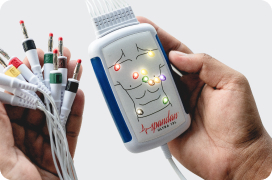
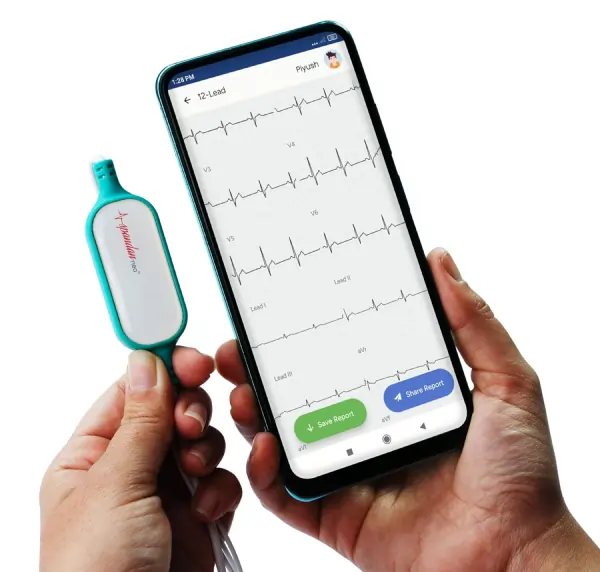
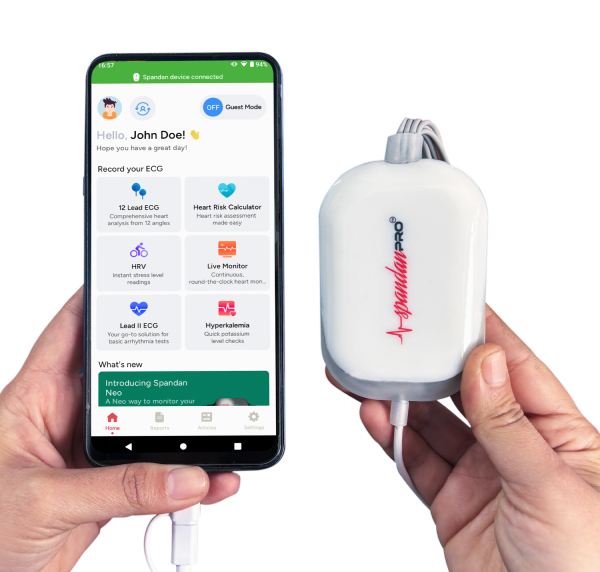
Chest-based electrode placement is what separates Spandan in the ECG vs smartwatch world. Unlike a wrist device, Spandan captures a full clinical-grade 12-view analysis — detecting Ischemia, Infarction, and even Hypertrophy (heart muscle thickening caused by long-term high blood pressure).
Choosing between ECG vs smartwatch becomes simple once you see what Spandan delivers — your smartphone transforms into a genuine diagnostic tool. It doesn’t just “track” your heart, it “tests” it. And when the ECG vs smartwatch choice truly matters — when symptoms strike — Spandan hands you a definitive medical-grade report, ready to share with your cardiologist instantly.
Who Should Never Rely Only on a Smartwatch?
Smartwatches are fine for young, healthy fitness enthusiasts tracking gym progress. But when it comes to ECG vs smartwatch for high-risk patients, there is simply no comparison. But for high-risk individuals, they are simply not enough:
People with Hypertension: High BP causes structural heart changes that a smartwatch cannot detect.
Diabetics: Diabetics frequently suffer “Silent Heart Attacks” without classic chest pain. Only a 12-lead-capable device like Spandan can catch these silent events.
Post-Surgical Patients: After a stent or bypass surgery, your heart needs professional-grade monitoring, not a fitness tracker.
Smokers and High-Cholesterol Patients: At high risk for plaque buildup and sudden arterial blockages.
The Psychological Impact: Anxiety vs. Empowerment
There is a growing phenomenon called “Cyberchondria” — where low-quality smartwatch data causes constant panic. Frequent “Low Heart Rate” or “Inconclusive ECG” flags lead to unnecessary stress and pointless ER visits.
A medical-grade device like Spandan provides clarity instead. Clinical-grade sensors and doctor-validated algorithms deliver reliable results, moving users from vague worry to informed action. You are not guessing based on a wrist light — you are reading the actual electrical signature of your heart muscle. This clarity is what makes the ECG vs smartwatch choice so obvious for anyone serious about heart health.
The Role of AI in Modern Heart Monitoring
Smartwatches use basic algorithms to find simple rhythm patterns — looking for “skips” in the beat. The ECG vs smartwatch intelligence gap is just as wide as the hardware gap.
Spandan uses advanced AI and Machine Learning trained on millions of clinical ECG strips — this is where ECG vs smartwatch differences become truly stark. It identifies subtle nuances like QRS complex slurring, T-wave inversion, and ST-segment elevation — the real signals of cardiac distress. In the ECG vs smartwatch AI battle, smartwatches simply count beats. Spandan interprets the complex language of your heart with cardiologist-level accuracy — and that ECG vs smartwatch gap could save your life.
ECG vs Smartwatch: What Cardiologists Actually Recommend
Technology evolves fast, but the human heart cannot afford to wait for a smartwatch to catch up. The ECG vs smartwatch gap today is not a minor technical difference — it is the difference between a timely diagnosis and a missed one. Smartwatches have genuinely changed how we think about personal health, and that is worth acknowledging. But awareness and diagnosis are two completely different things. If you wear a smartwatch, keep it for fitness motivation, step tracking, and sleep monitoring. But if your heart health is a real priority — especially if you carry any risk factors — the ECG vs smartwatch choice becomes obvious. Clinical grade wins every single time. Spandan exists because your heart deserves far more than a wrist sensor and a green light.Â
Conclusion: Don't Gamble with Your Heart
Smartwatches use basic algorithms to find simple rhythm patterns — looking for “skips” in the beat. This is another dimension of the ECG vs smartwatch gap that most people overlook: the intelligence gap.
Spandan uses advanced AI and Machine Learning trained on millions of clinical ECG strips, identifying subtle nuances like QRS complex slurring, T-wave inversion, and ST-segment elevation — the real signals of cardiac distress. When it comes to ECG vs smartwatch AI capability, there is simply no comparison. Our AI doesn’t just count beats; it interprets the complex language of your heart with cardiologist-level accuracy.